


Dec. 18, 2025, marks the 185th anniversary of Bradley County’s establishment, a moment that came when Arkansas was still a young state and south Arkansas remained largely frontier, shaped as much by policy and promise as by wilderness.
When Bradley County was created on Dec. 18, 1840, the land was dense with pine and hardwood forests, threaded by creeks, bayous and the slow-moving Saline River. Travel was difficult and uncertain. Settlers moved by horseback or wagon along narrow trails cut through the woods, often following old Native paths or traces worn by traders. Roads were few, bridges rare, and isolation was a fact of daily life.
Many of the men who came to this region in the decades before county formation were veterans of the War of 1812, drawn west by the federal government’s promise of land. In lieu of pensions, thousands of former soldiers received land warrants—certificates that could be redeemed for acreage in the expanding frontier. Arkansas Territory, with its vast tracts of inexpensive, unsettled land, became a destination for those seeking opportunity after war.
For veterans, Arkansas offered a chance at independence. Land ownership meant stability, status, and something to pass down to children. For others—farmers from worn-out soils in the Carolinas, Georgia, and Tennessee—the move west promised fertile ground and a fresh start beyond the reach of crowded towns and entrenched hierarchies.
Homes were built from the timber that surrounded them. Log cabins were raised with the help of neighbors in communal efforts, not only because help was needed, but because cooperation was essential to survival. Families lived largely from what they could grow or harvest. Corn was the staple crop. Hogs roamed freely in the woods. Deer, turkey, and fish supplemented the table. Cash was scarce, and barter common.
Bradley County itself came into existence by act of the Arkansas General Assembly, formed from portions of Union, Drew, Ashley and Cleveland counties. For settlers spread across the region, the creation of a new county was more than a political act. It meant courts that could be reached without days of travel, deeds recorded closer to home, and disputes settled locally rather than by distant authority.
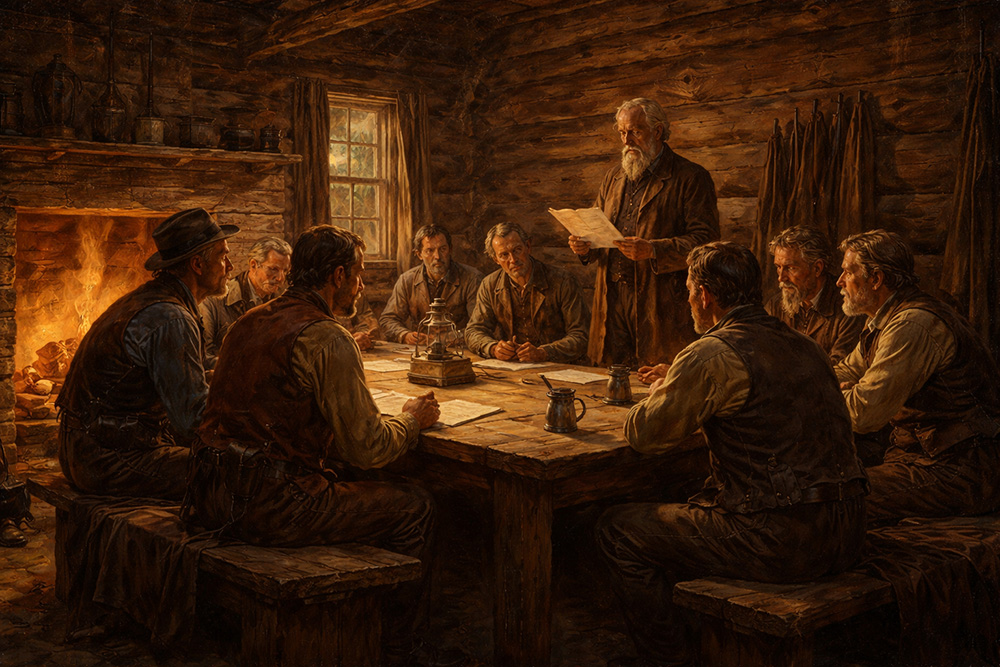
The county was named for Capt. Hugh Bradley, a War of 1812 veteran who had served under Andrew Jackson and later helped lead pioneer families into south Arkansas during the 1820s. Like many early settlers, Bradley represented the convergence of military service and westward movement. In the absence of public buildings, his home served as an early center of county business, where neighbors gathered to conduct the practical work of government.
The county seat was established at Warren, then known as the Pennington Settlement. It was little more than a clearing in the forest, but its location made it suitable for trade and governance. Slowly, stores appeared. Lawyers and preachers followed. What began as a settlement grew into a town where civic life took form.
Early records show the first property deed was recorded in March 1841, with court proceedings beginning the following month. These handwritten entries marked the transformation of wilderness into organized society—land measured and claimed, authority established, and community formalized.
For those living in Bradley County in 1840, life was physically demanding and uncertain, shaped by weather, labor and distance. Yet it was also communal and purposeful. The people who settled the county believed they were building something lasting, even if they could not see what it would become.
One hundred eighty-five years later, Bradley County still reflects the choices made in those early years—by veterans seeking land, families seeking opportunity, and communities shaped by both the promise and hardship of the frontier.