




By Mary Hightower
University of Arkansas Division of Agriculture
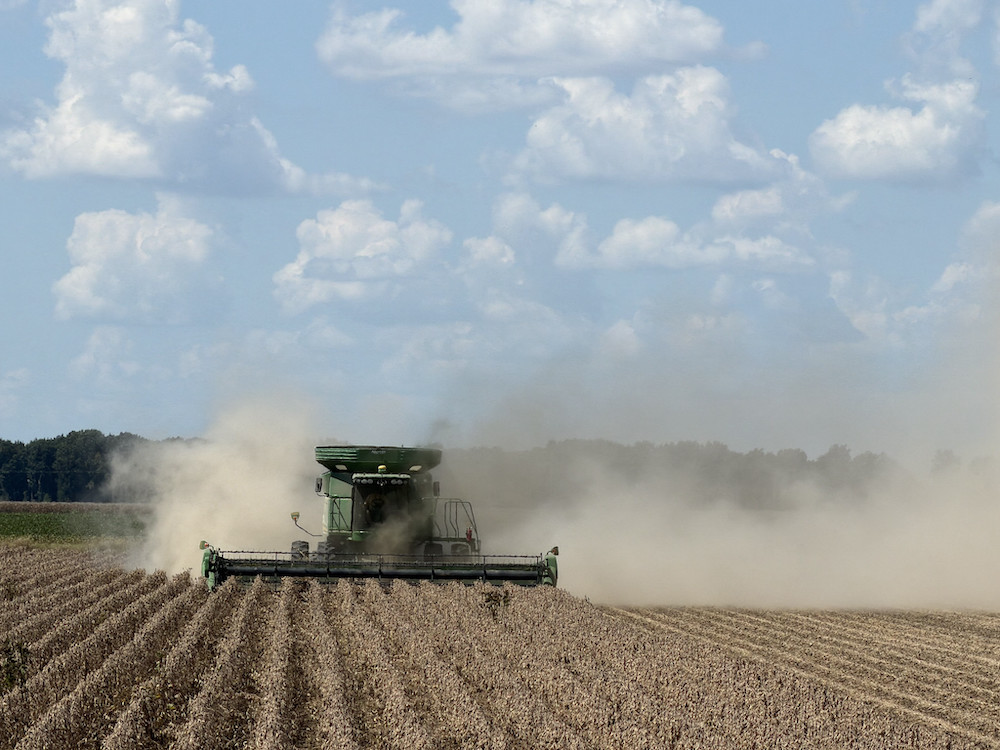
NEWPORT, Ark. — Dry weather is keeping the combines rolling in Arkansas corn, rice and soybeans, and the high heat is driving cotton toward the beginning of its harvest.
Meanwhile, farmers are coping with higher costs to harvest.
This week’s Crop Progress report from the U.S. Department of Agriculture’s National Agricultural Statistics Service shows the state’s corn at 65 percent harvested, up from 42 percent last week and well ahead of 2025’s 54 percent and the 35 percent five-year average.
“With the forecast for hot, dry weather over the next week, corn harvest should continue to progress rapidly,” said Jason Kelley, extension wheat and feed grains agronomist for the University of Arkansas Division of Agriculture.
The Little Rock National Weather Service forecast through Labor Day shows no rain, and the heat isn’t expected to dissipate soon either. The National Weather Service published a six-day heat risk map that showed large swaths of extreme heat across the Arkansas Delta and Arkansas River Valley through Saturday.
Rice jumped to 33 percent harvested, up from last week’s 16 percent. Rice was 24 percent harvested at this time last year. The five-year average is 18 percent.
“As expected, rice progress is picking up steam — pun intended — in this heat,” said Jarrod Hardke, extension rice agronomist for the Division of Agriculture. “Dry conditions are dropping grain moistures quickly, and the rice will be outrunning us with this forecast.
“The 2024 season is the only one in recent years to have a faster harvest progress to this point,” he said. “Well over half of the state’s rice will likely have been harvested by the end of this week. Yields remain mostly strong, but variables related to water management, heat and pop-up thunderstorms have emerged as issues.”
Soybeans went from 4 percent harvested last week to 16 percent this week. It’s ahead of last year’s 10 percent rate and the 5 percent five-year average.
“Soybean harvest is starting to pick up speed,” said Jeremy Ross, extension soybean agronomist for the Division of Agriculture. “As farmers finish up their corn and rice harvest, soybean harvest will begin to really pick up.”
However, farmers are seeing the effects of the high heat in their crops.
“The soybean crop planted during March and the first part of April is being harvested now,” he said. “Yields seem to be average at best due to the high temperatures. Some of the early planted acreage has more flat, unfilled pods than normal due to the extreme temperatures we have seen.
However, Ross said, “The later planted soybean crop seems to have better pod fill.”
“We could see similar problems if we continue to see daytime temperatures in the upper 90s and higher,” he said.
Meanwhile, harvest time is approaching for cotton, helped in part by the weather.
“This prolonged heat has cotton fields beginning to turn white across the state,” said Zachary Treadway, extension cotton and peanut agronomist for the Division of Agriculture.
“If this heat keeps up, I could see us starting to pick a lot of cotton by the middle to end of this month,” he said. “If the Gulf remains quiet, cotton harvest could mirror the other crops and move along quickly.”
Cost to harvest
Scott Stiles, extension economics program associate for the Division of Agriculture, said there are pros and cons to the weather.
“The dry conditions are certainly allowing the harvest to move quickly and with lower grain drying costs,” Stiles said. “We’d much rather have that as opposed to an active lineup of storms in the Gulf.”
Additionally, “we are seeing continued strength in grain and cotton prices as the calendar flips to September. That’s something we typically don’t see during harvest,” Stiles said. “This is helpful as diesel prices are also making a run higher.”
In the last month, diesel jumped about 22 percent and is close to the yearly highs that occurred in March, he said.
“In rice harvest, some of the larger combines are burning through 28 gallons an hour,” Stiles said. “At current prices, an average day’s fuel bill is about $1,100 per machine. There are a lot of variables there, but it is roughly double what growers were paying a year ago.”
To learn about extension programs in Arkansas, contact your local Cooperative Extension Service agent or visit uaex.uada.edu. Follow us on Facebook and Instagram. To learn more about the Division of Agriculture, visit uada.edu. To learn more about ag and food research in Arkansas, visit the Arkansas Agricultural Experiment Station at aaes.uada.edu.
About the Division of Agriculture
The University of Arkansas Division of Agriculture’s mission is to strengthen agriculture, communities, and families by connecting trusted research to the adoption of best practices. Through the Agricultural Experiment Station and the Cooperative Extension Service, the Division of Agriculture conducts research and extension work within the nation’s historic land-grant education system.
The Division of Agriculture is one of 22 entities within the University of Arkansas System. It has offices in all 75 counties in Arkansas and faculty on three campuses.
Pursuant to 7 CFR § 15.3, the University of Arkansas Division of Agriculture offers all its Extension and Research programs and services (including employment) without regard to race, color, sex, national origin, religion, age, disability, marital or veteran status, genetic information, sexual preference, pregnancy or any other legally protected status, and is an equal opportunity institution.