


The ongoing heatwave might keep most hunters out of the woods right now, but skipping your pre-season stand safety check is a recipe for disaster. A quick trip to inspect your stand and hunting location is well worth the effort if it means coming home safely at the end of each hunt later this year.
By Randy Zellers, Arkansas Game and Fish Commission.
According to Matt Gideon, Hunter Education and Boater Education Coordinator for the Arkansas Game and Fish Commission, treestand falls account for 75 to 80 percent of hunting accidents each year, and many result in major injuries and even death.
“Right now, you want to go out and inspect all of the welds, straps and cables carefully on your stands,” Gideon said. “And if it’s been out all year, it’s almost a sure thing that you need to replace those straps holding it to the tree. Ideally, you should take the stand down at the end of every season, and I probably wouldn’t trust one that’s been up all year without going ahead and taking it down to give it a thorough inspection and replacing any worn parts. Squirrels and rats can chew up the straps, and just sitting in the elements all year can weaken the materials.”
Gideon, an avid hunter who started at the AGFC’s Charlie Craig Fish Hatchery in Centerton before transitioning to the agency’s Education Division, coordinates with the AGFC’s Enforcement and Education divisions to compile the agency’s annual Hunter Incident Report as part of his duties.
“We produce the report each year so Hunter Education instructors can relay valuable lessons learned from previous years’ accidents,” Gideon said. “It also lets us take a look at trends in lapses of judgment or safety that we can address in our classes and offer advice about possible regulations changes that are needed to keep up with changes in hunting styles and technology.”
Gideon says misuse of safety harnesses is a leading cause of treestand falls. Just about every treestand made comes with a complimentary safety harness, and many aftermarket harnesses are not only comfortable, but have accessory pockets to hold hunting gear. Still, lack of a safety harness remains the number one cause of most treestand fall injuries.
“A lot of people either aren’t wearing their harnesses or not wearing them properly,” Gideon said. “They may have them on, but they are unattached during the climb up or down, and that’s when a lot of our treestand falls happen.”
Gideon says that negotiating that transition safely requires the use of a special rope called a lifeline that is tied to the tree throughout the season.
“You attach your harness to it, and it uses a special knot called a Prusik knot that slides up and down, but locks down tight when it is yanked hard and keeps you safe,” Gideon said. “You install the lifeline above the stand when you’re setting it up, and that way you always have that extra point of contact with the tree from the time you leave the ground until you return at the end of your hunt.”
The Mayo Clinic estimates that one in three hunters who use tree stands will experience a fall sometime in their hunting career. The use of a safety harness when that occurs can be the difference between a moment of fright and a lifetime of injury, even death.
Gideon says that fatalities have occurred from as little as 8 feet high, and most hunters go much higher than that.
“Jumping down from 10 feet is one thing, but falling unexpectedly is a different story,” Gideon said. “Plus, you often have a loaded firearm or bow with you that adds more danger to the situation. There’s really no excuse not to wear one, and when worn properly, you really forget that it’s there.”
Gideon says most hunters probably overestimate the height they set their stands, with the majority of deer stands being set at roughly 12 to 15 feet off the ground, but he’s seen some that were extremely high.
“You know, a lot of deer get killed by people in ground blinds, leaned up against the base of a tree or maybe brushed in a little on the ground — you don’t have to climb that high,” Gideon said. “Be still and monitor your scent; a lot of deer are taken that way.”
Gideon says it’s also important to remember that only 16 hunting incidents were reported last year, and only two of those were fatal.
“We don’t take any injury or fatality lightly, but Arkansas had nearly 300,000 hunters in the woods last year, so the injury rate reported comes out to be eight one-thousandths of a percent,” Gideon said. “Golf, on the other hand, has nearly twice the injury rate, at 0.016 percent.”
Visit www.agfc.com/huntered for more information on hunting safety and a copy of the Fiscal Year 2026 Hunter Incident Report.
CUTLINES:
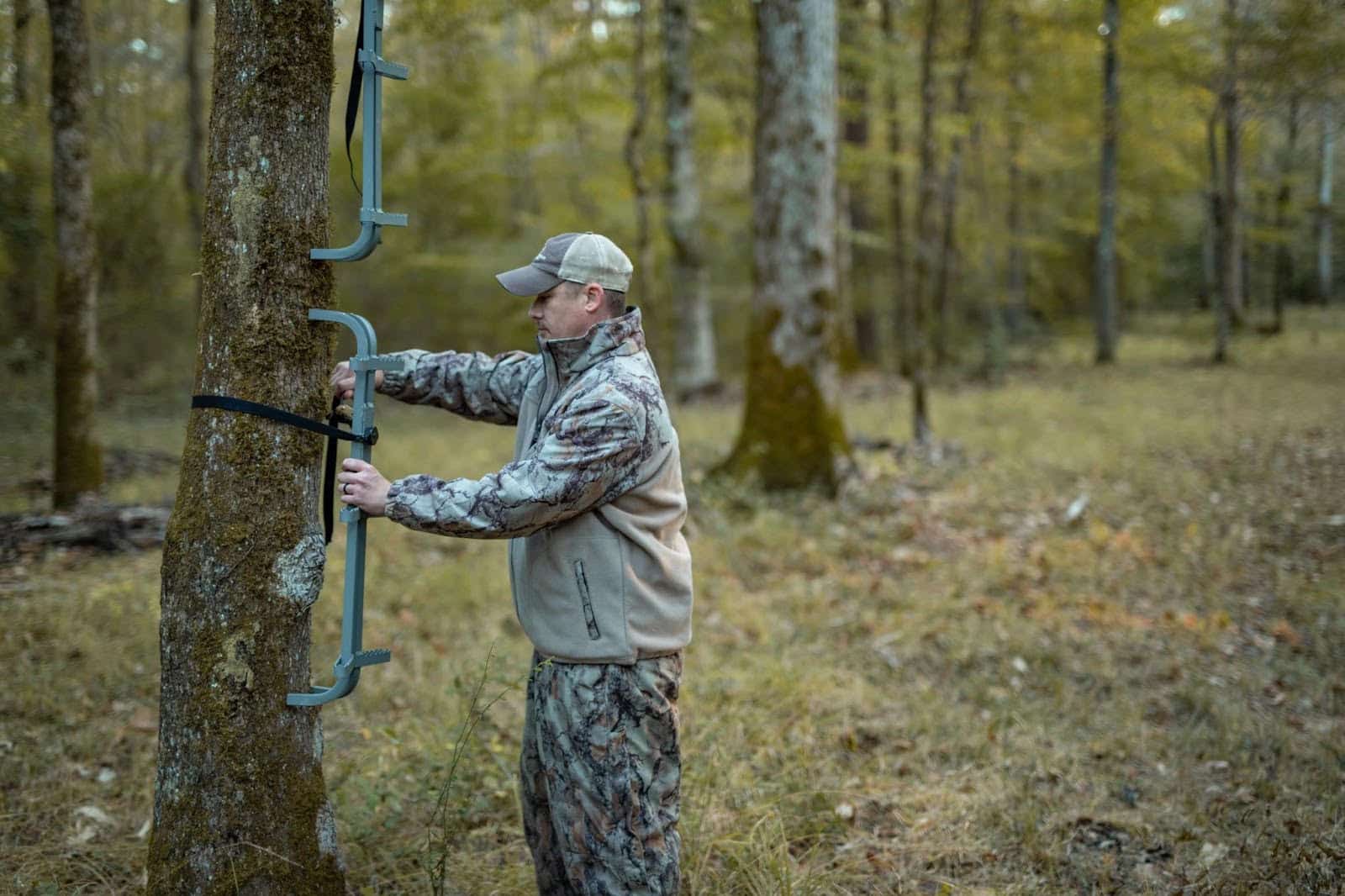
CHECKING TREE STEPS
It’s a good idea to inspect all straps and materials on your tree stand, including your tree steps, now to prevent injury later in the season. AGFC photo.
WEARING HARNESS
Putting on your safety harness at the truck can prevent a jumbled mess of straps and tangles to figure out when you arrive at the tree. AGFC photo.
LOCKING TO LIFE LINE
A life line can save you from a fall during the climb up to the stand as well as the transition from the ladder to the platform. AGFC photo.