




For a brief period during the Great Depression and World War II, a stretch of southwest Arkansas became the center of an industry that today is almost entirely forgotten.
Miners dug into the Ouachita foothills in search of cinnabar, the bright red ore from which mercury could be extracted. Investors arrived. Mining companies formed. Communities hoped the discovery might bring desperately needed jobs and prosperity to one of the poorest states in the nation.
Then, almost as quickly as the industry appeared, it was gone.
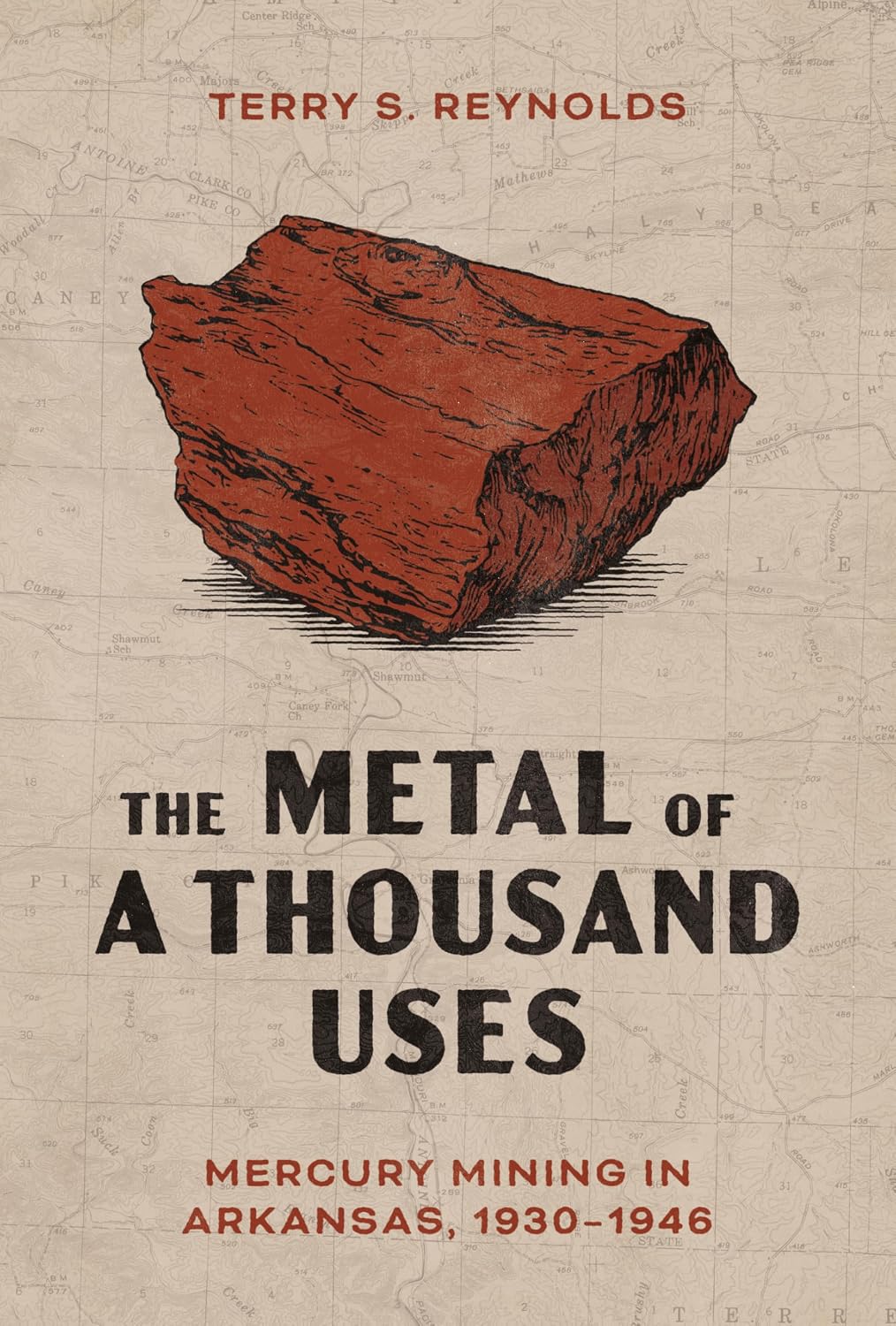
That largely forgotten chapter of Arkansas history is the subject of Terry S. Reynolds’ new book, The Metal of a Thousand Uses: Mercury Mining in Arkansas, 1930–1946, published in 2026 by the University of Arkansas Press.
It is a remarkably specific subject for a nearly 300-page book, but that specificity is part of what makes Reynolds’ work interesting. Rather than attempting another sweeping history of Arkansas, he takes one unusual episode and uses it to tell a much larger story about poverty, economic development, natural resources, war and the almost irresistible promise of a new industry.
The Arkansas mercury story began with the discovery of cinnabar in southwest Arkansas in 1930. The resulting mining district stretched roughly 30 miles across portions of Howard, Pike and Clark counties, with most of the mines located in Pike County. At least 67 mines and prospects were eventually identified in the district, although only about 10 accounted for most of its production.
For Arkansans living through the Depression, the discovery seemed to offer something badly needed: opportunity.
Reynolds argues that enthusiasm for mercury mining was extraordinarily widespread despite the dangers already associated with the industry. Arkansas’ poverty, along with the apparent possibility that relatively small operators could enter the business, helped fuel hopes that mercury might provide a new source of prosperity.
Those hopes would prove short-lived.
Arkansas’ mercury deposits were ultimately too small and scattered to sustain a major long-term industry. World War II temporarily gave mining new life as mercury became strategically important and government support helped bolster production. Mercury compounds had military applications, including their use in ammunition primers, while access to some major overseas sources had become uncertain.
Arkansas produced approximately 11,400 standard 76-pound flasks of mercury between 1931 and 1944. By 1946, however, significant mining had essentially ended.
Reynolds organizes the book around that rise and fall. Chapters move from an explanation of mercury itself and Arkansas’ troubled economy in the 1920s through the excitement surrounding the discovery, the industry’s early difficulties, its wartime revival and eventual collapse. A later chapter turns specifically to the experiences of people who worked in the Arkansas mercury mines.
That structure gives The Metal of a Thousand Uses value beyond mining history.
At its heart, this is a story familiar to many rural communities: a struggling region discovers what appears to be a new economic lifeline, public enthusiasm builds around the promise of jobs and investment, outside economic forces intervene, and eventually the reality of the resource fails to match the original hopes.
That makes the story feel surprisingly modern.
Reynolds also approaches the subject from an unusual personal perspective. He grew up near El Dorado, studied history at Southern Arkansas University and later became a professor of history at Michigan Technological University, where his scholarly interests included mining and the history of technology. After retiring to South Arkansas, Reynolds came across a reference to Arkansas mercury mining and realized that, despite growing up in the state, he had never known the industry existed. That curiosity eventually developed into the research behind the book.
That may be the book’s most compelling selling point for Arkansas readers.
There are portions of Arkansas history almost everyone recognizes: the Civil War, the oil boom, agriculture, timber, the Little Rock Central High School crisis and the state’s colorful political history. Mercury mining is different. Even lifelong Arkansans may encounter the subject and wonder how an entire mining industry could have existed in southwest Arkansas without them ever hearing about it.
Reynolds himself was one of them.
For the casual reader, The Metal of a Thousand Uses should be approached as a serious work of history rather than a light popular-history narrative. Its 294 pages include extensive attention to the economics, geology, companies and technology surrounding the industry, along with notes, production statistics and information on individual mining companies and leading mines.
But for readers interested in Arkansas history, that depth is also the book’s strength. Reynolds has taken an obscure episode that might otherwise merit only a paragraph or two in a general history of the state and reconstructed the world surrounding it.
The result is a reminder that Arkansas history is filled with stories hiding just below the surface.
In this case, quite literally.
The Metal of a Thousand Uses: Mercury Mining in Arkansas, 1930–1946 by Terry S. Reynolds is published by the University of Arkansas Press. The book is 294 pages and was released in 2026.