



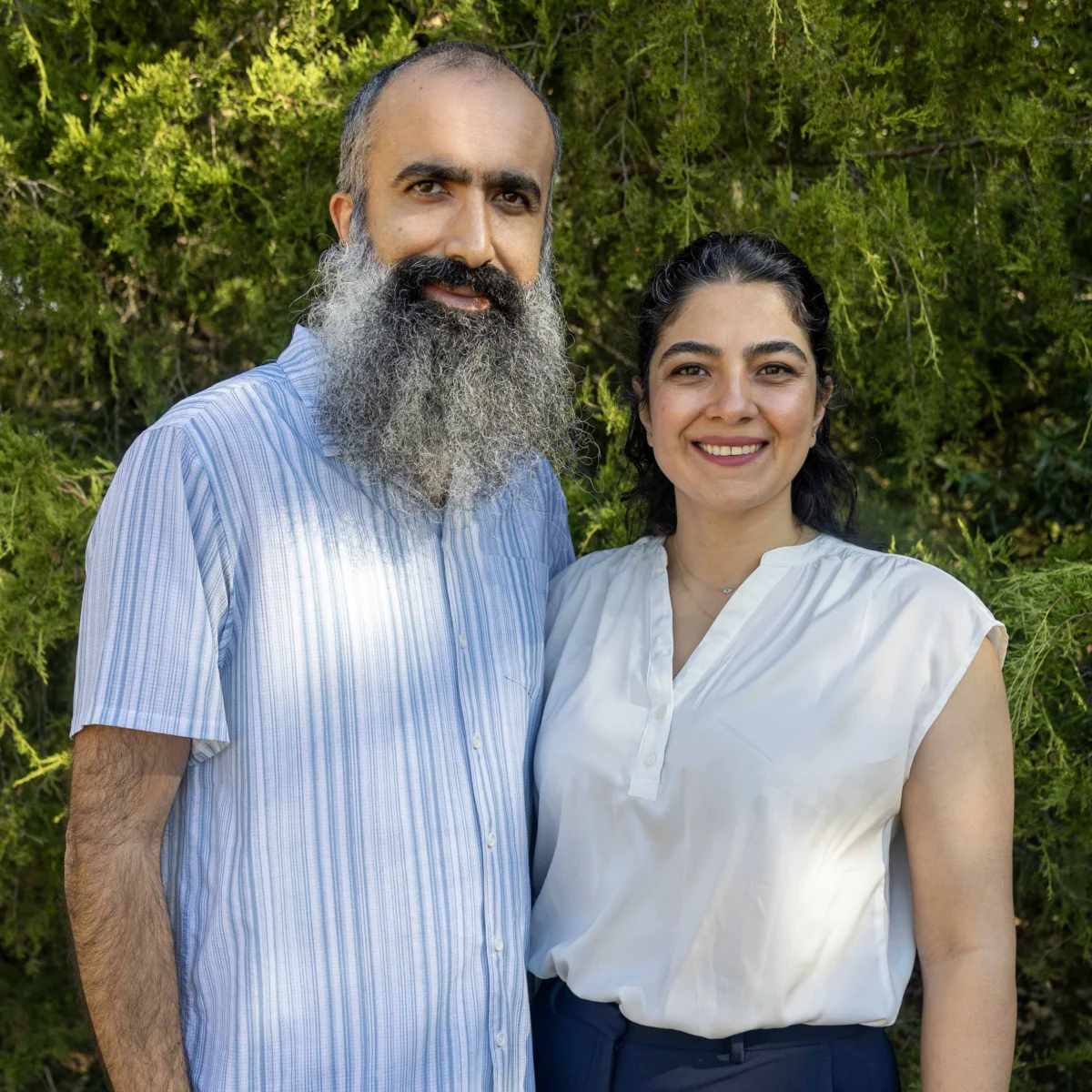
The University of Arkansas at Monticello College of Forestry, Agriculture and Natural Resources has welcomed two new faculty members whose expertise in forest engineering and forest ecohydrology will expand opportunities for teaching, research and student engagement in sustainable forest management, forest infrastructure and water-resource conservation.
Married faculty members Dr. Azade Deljouei, a forest engineer, and Dr. Seyed Mohammad Moein Sadeghi, a forest ecohydrologist, bring complementary expertise to UAM’s forestry program. Their work spans forest-roads engineering, soil erosion and stabilization, silviculture, and the complex relationships between forests and water resources.
Finding a home among foresters
Deljouei and Sadeghi are excited to join a community where forestry is a shared area of expertise and where their research interests naturally complement those of their colleagues.
“Being part of a group with so many people who have a strong background in forestry is really exciting,” Sadeghi said. “We can share ideas, build on each other’s expertise and have conversations that lead to new opportunities for research and teaching.”
In addition to the opportunity for collaboration, both value UAM’s student-focused campus environment, which allows faculty members to work closely with students and serve as mentors throughout their academic careers.
“UAM offers the opportunity to work closely with students and colleagues while making a meaningful impact through our teaching and research,” Sadeghi said.
Deljouei said Arkansas’ abundant natural resources and UAM’s access to forestland provide valuable opportunities for hands-on learning and help make the college an attractive choice for students interested in natural resources.
“Arkansas has so much to offer, and UAM is in a great position to take advantage of those resources in our teaching and research,” she said. “We can give students opportunities to learn in the field while showing them what makes this college such a great place to study forestry and natural resources.”
Both said they have enjoyed the welcoming nature of the UAM community and the opportunity to work in the Natural State.
A passion for forest engineering
Deljouei’s interest in forestry began with a childhood spent outdoors. Growing up, she spent weekends on her father’s small farm, surrounded by grapes, apples and other trees. When she entered college, she initially gravitated toward engineering and soon discovered that forest engineering brought together her interests.
She earned a master’s degree in forest engineering, focusing on forest road design and maintenance and the role of roads in timber harvesting. Her master’s research also examined how forest roads affect the surrounding environment, including vegetation diversity, soil compaction and soil chemistry.
During her doctoral studies, her research broadened to include soil erosion and slope stability. She became particularly interested in soil-root interactions and soil bioengineering, an approach that uses vegetation and root systems to help hold soil in place, stabilize slopes and reduce erosion.
By combining engineering principles with natural processes, her work explores more sustainable ways to manage forest roads and other infrastructure while protecting the surrounding environment.
At UAM, Deljouei is developing a forest engineering course focused on the planning, design, construction and maintenance of forest roads. Topics will include drainage design, erosion control, environmental impacts and best management practices. Students will learn how to balance the operational needs of timber harvesting with the protection of forest soils and water resources.
“I want my research to contribute practical solutions for improving rural forest roads in Arkansas, particularly by reducing soil erosion, improving drainage and increasing road stability,” Deljouei said. “These roads play an important role in moving timber from the forest to market, but they’re also part of everyday life for people who live and work in rural communities.”
She sees opportunities to work with forestry companies, landowners and local officials to address road conditions and erosion, while also exploring ways roots and vegetation can stabilize roads, slopes and other vulnerable areas.
She is excited about the opportunity to help expand forest engineering education at UAM and throughout the region.
“There’s a real opportunity for UAM to expand forest engineering education in the South and prepare students to tackle challenges in forest management, engineering and environmental sustainability,” Deljouei said.
Deljouei will work as part of the college’s Arkansas Center for Forest Business.
“Dr. Deljouei is joining UAM and our business center at the perfect time,” said Dr. Michael Blazier, dean of the UAM College of Forestry, Agriculture, and Natural Resources.“One of the center’s major initiatives is helping counties across Arkansas improve rural roads that are essential to timber transportation. Her expertise will support an important part of the forestry economy while providing our students with unique opportunities in forest engineering.”
Following water through the forest
For Sadeghi, a lifelong appreciation for trees eventually led to a career in forest ecohydrology, a field that examines how vegetation, soils and ecological processes interact with the water cycle.
His father instilled in him an appreciation for trees and the environment, including a fascination with the Persian cypress. That early connection to trees helped shape his decision to pursue forestry.
As a student, Sadeghi became particularly interested in dendrology, the study of trees, and silviculture, the practice of establishing, growing and managing forests. He later discovered forest hydrology, which became a central focus of his research.
His master’s research examined the hydrological effects of tree plantations in a semiarid environment, leading him to explore the relationships among forests, water and the environment. His doctoral research continued that work by examining water balance in different forest ecosystems using empirical, process-based and machine-learning modeling approaches.
Today, Sadeghi’s research focuses on forest ecohydrology, or how water moves through and interacts with forest ecosystems. He examines how forest structure, tree species, management practices and environmental disturbances affect water movement, storage and quality. His work connects processes above the forest floor, including how tree canopies and bark intercept rainfall, as well as belowground processes such as soil-water movement, infiltration and groundwater recharge.
At UAM, he plans to develop courses and research opportunities that help students understand how water moves through a forest, from rainfall reaching the tree canopy to water entering the soil, replenishing groundwater and eventually reaching streams and wetlands. His teaching plans include undergraduate watershed management and a graduate-level course in forest ecohydrology, emphasizing the connections between ecological processes, hydrological measurements and sustainable forest management.
“I want to connect aboveground and belowground hydrology,” he said. “My research examines what happens to rainfall after it reaches a forest: how much is intercepted by leaves and bark, how much reaches the forest floor, how water moves through the soil, and how these processes ultimately influence groundwater and streamflow. Understanding these connections is essential for managing forests while protecting water resources.”
His research will also explore how disturbances such as timber harvesting, drought, fire, disease and other changes in forest conditions can affect water quantity and quality. Of particular interest are the hydrological consequences of forest management activities, including harvesting, road construction and prescribed burning, as well as the impacts of extreme weather events. These disturbances can alter infiltration, runoff, erosion, sediment transport and streamflow, with important implications for forest productivity and watershed health.
Sadeghi hopes to develop undergraduate research opportunities that allow students to collect and analyze field data while learning practical experience in plot establishment, GPS use, water-quality sampling and measurements of tree and stream characteristics. Students may also gain experience with rainfall monitoring, soil-moisture sensors, hydrological data analysis and other field-based techniques used to investigate forest-water interactions.
Along with his teaching appointment, Sadeghi will hold a research appointment with the Arkansas Forest Resources Center, a partnership between the University of Arkansas Division of Agriculture and UAM that advances forest sustainability through research and extension.
“Forest management involves more than trees. It also includes understory plants, wildlife and water resources, particularly in Arkansas’ extensive wetland forests,” said Blazier, who also serves as director for the Arkansas Forest Resource Center. “Flooding and drought create ongoing challenges, and Dr. Sadeghi brings valuable expertise to help us better understand and manage water resources in forest ecosystems through research and teaching.”
Together, Deljouei and Sadeghi expand opportunities for student research and applied forestry education while creating new possibilities for collaborative work on forest infrastructure and watershed health. Through research, teaching and engagement with forest managers and landowners, they hope to contribute practical solutions that support sustainable forestry and healthy watersheds in Arkansas.
About the College of Forestry, Agriculture and Natural Resources and the Arkansas Forest Resources Center
TheCollege of Forestry, Agriculture and Natural Resources, and the Arkansas Forest Resources Center, a University of Arkansas System Center of Excellence, brings together interdisciplinary expertise through a partnership between theUniversity of Arkansas at Monticelloand the University of Arkansas Division of Agriculture. The College and Center are headquartered at the University of Arkansas at Monticello campus, but their programs range statewide with the mission of developing and delivering teaching, research, and extension programs that enhance and ensure the sustainability and productivity of forest-based natural resources and agricultural systems. Academic programs are delivered by the College of Forestry, Agriculture, and Natural Resources through the University of Arkansas at Monticello. Through the University of Arkansas Division of Agriculture, research is administered by the Arkansas Agricultural Experiment Station, and extension and outreach activities are coordinated by the Arkansas Cooperative Extension Service.
Academics,College of Forestry, Agriculture and Natural Sciences,Appointments
Article courtesy of the University of Arkansas at Monticello.