
FAYETTEVILLE, Ark. — An ancient horticultural practice that’s finding new adherents and applications, such as the rooftop garden at the University of Arkansas Student Union, is being celebrated May 4-8 during Compost Awareness Week.
Matt Bertucci, an assistant professor of horticulture, has made compost a central part of his research for the past three years.
While working on the NWA Specialty Crop Soil Health Program, we learned that 63 percent of participating growers were using compost as a soil amendment,” he said. “So, we wanted to investigate how to most effectively use compost to improve soils.”
Compost Awareness Week will include web-based lunch-and-learns and in-person events in northwest Arkansas discussing the research and other information related to compost use.
“Each of these events will showcase professionals, enthusiasts and volunteers who are involved in the composting process,” said Bertucci, a faculty member with the University of Arkansas Division of Agriculture and the Dale Bumpers College of Agricultural, Food and Life Sciences at the University of Arkansas.
Compost Awareness Week partners include the Arkansas Student Union, Fayetteville Public Schools, the City of Fayetteville, Food Loops and the Washington County Master Composters.
Event schedule
- Monday, May 4, noon-1 p.m. — “Compost 101” — lunch-and-learn webinar, with Washington County Extension Agent Colin Massey and “Composting with the City of Fayetteville,” with Faebyan Whittle, environmental educator, City of Fayetteville.
- Tuesday, May 5, noon-1 p.m. — “Campus Composters!” webinar, featuring interviews with Fayewtteville High School students, Lance Grigsby and James Huff.
- Wednesday, May 6, noon-1 p.m. — “Compost 201:” Using Compost on Your Farm” — lunch-and-learn webinar — “Digging Deeper: Compost as a Soil Amendment,” with Bertucci, and “ Bertucci and “Bioassays: How to Check for Issues with Your Compost,” with Ph.D. student and researcher Rachel Woody-Pumford.
- Thursday, May 7, 5 p.m.-7 p.m. — Composting networking event, Fossil Cove Brewing, 1946 N. Birch Ave., Fayetteville.
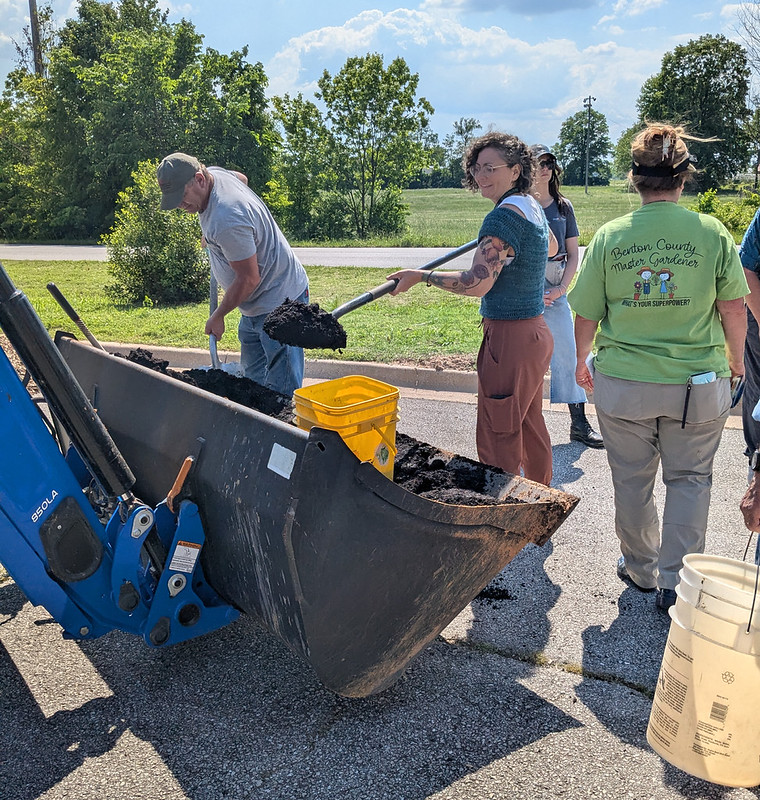
- Friday, May 8, 9:30 a.m.-noon — Compost in Action Field Day, Washington County Extension office, 2536 N. McConnell Ave., Fayetteville. Attendees are encouraged to bring their own bucket for free compost. Register online.
There is no cost to attend.
Digging into the research
While many people make their own compost, some rely on municipal sources. In his research, Bertucci said it was noticed that growers are working with limited information about the compost they receive.
“From a regulatory perspective, compost is treated as a waste product,” Bertucci said. “The standards are set to ensure that permitted compost facilities pose no harm to humans or to the environment from contamination with harmful bacteria or trace elements such as lead or arsenic.
“However, there is no requirement to test or report the characteristics of compost as a soil amendment such as nitrogen, phosphorus and potassium.”
To address this gap, Ph.D. student Rachel Woody-Pumford is testing the soil amendment properties of compost produced at nine Arkansas Division of Environmental Quality-permitted facilities. Paired with that work, she is conducting a tomato trial to investigate the effects of compost as a soil amendment and to track the nutrient uptake between the soil and plants. Woody-Pumford is also conducting a regional survey of compost users to determine the greatest concerns and barriers to compost use in the Southeastern vegetable production.
James Huff, a Bumpers College honors student, was selected to the EcoREU program and will use compost as a substrate for his jalapeño pepper garden on top of the Arkansas Student Union.
Esther Moore, another Bumpers College honors student, recently conducted a greenhouse bioassay to determine the sensitivity of pumpkins to potential herbicide contaminants in composted materials.
“We want our data to inform producers how to most effectively and safely use compost to produce local food,” Bertucci said. “In the future, we hope to extend this work into outreach for best practices to produce compost either at home, on-farm, or at a municipal level.”
Learn more about composting on Bertucci’s YouTube channel. Recorded webinars will be posted to this channel.
To learn about extension programs in Arkansas, contact your local Cooperative Extension Service agent or visit uaex.uada.edu. Follow us on Facebook and Instagram. To learn more about the Division of Agriculture, visit uada.edu. To learn more about ag and food research in Arkansas, visit the Arkansas Agricultural Experiment Station at aaes.uada.edu.