




When Americans think about Columbus Day, the story usually begins in 1492, when Christopher Columbus crossed the Atlantic, reached the Americas and set in motion events that would transform two hemispheres. But for Bradley County, perhaps a more interesting year to consider is 1491.
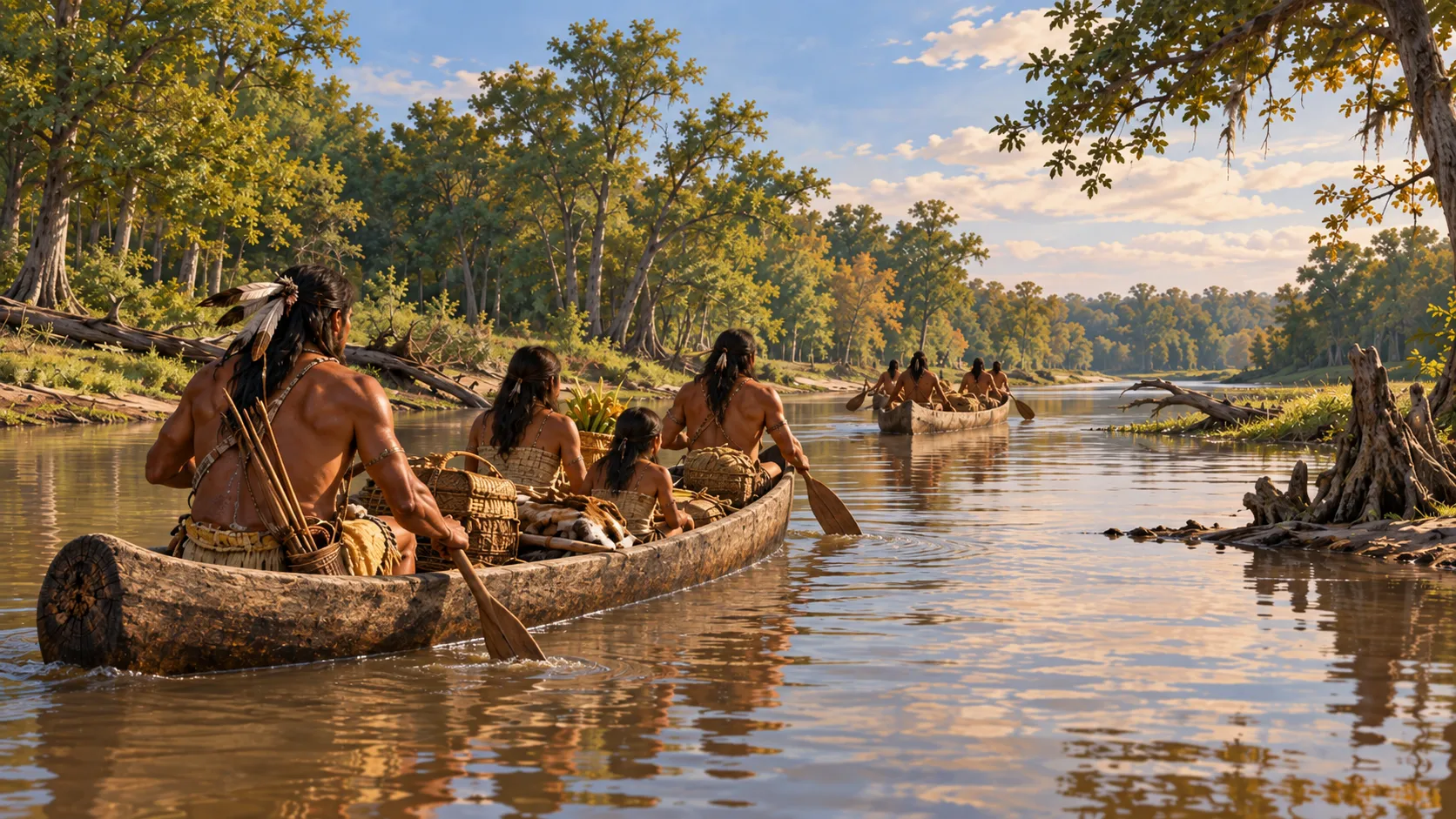
What was happening here one year before Columbus arrived? What would a person have found walking through the forests around present-day Warren, following the Saline River or standing along the Ouachita near Moro Bay? There would have been no Warren, no Hermitage, no Bradley County and no Arkansas, but the land would not have been empty. Far from it.
Looking at America from 1491
That change in perspective is at the heart of Charles C. Mann’s book 1491: New Revelations of the Americas Before Columbus. Mann draws on decades of archaeological and anthropological research that challenged an older picture of the Americas as a largely untouched wilderness sparsely inhabited before Europeans arrived.
Instead, researchers have found evidence of large populations, agriculture, trade networks, cities and societies that actively shaped the landscapes around them. 1491 is not a history of Bradley County, and it would be wrong to assume that every society Mann describes existed here in the same form, but the book raises a useful local question: What have we missed by starting our history too late?
People were here long before Bradley County
According to the Encyclopedia of Arkansas, humans have inhabited what is now Bradley County for more than 10,000 years. Around 140 archaeological sites have been recorded in the county, including campsites, cemeteries and mound sites, and by sometime after A.D. 1000, people living in this area were also cultivating domesticated crops.
That 10,000-year figure, however, should not necessarily be treated as the beginning of human life here. It is better understood as what the archaeological record presently allows us to say with confidence about Bradley County. Elsewhere in the South, discoveries have pushed the human timeline much farther back.
One of the best-known examples is the Gault Site in Central Texas, where archaeologists have uncovered stone tools and other evidence dating to roughly 16,000 to 20,000 years ago. The site helped challenge the once-common belief that the Clovis culture, about 13,000 years ago, represented the earliest people in North America.
Gault does not prove people were living in Bradley County 20,000 years ago, but it does show that the human story in this part of the continent may go much deeper than archaeologists once believed. Ten thousand years should not necessarily be thought of as a starting line.
What did this place look like?
A modern Bradley County resident transported back to 1491 would recognize very little. There would be no roads, farms, towns, churches or property lines, but the rivers would still be here. The Saline would still be flowing, and so would the Ouachita.
Those waterways would have served as natural transportation routes while also providing food, water, fertile ground and access across the region. And despite the temptation to imagine an endless untouched wilderness, Mann’s 1491 reminds readers that Native peoples across the Americas often actively managed the land around them.
They hunted, farmed, used fire, encouraged useful plants and shaped the environments where they lived. Exactly how extensively people altered the forests of Bradley County in 1491 is difficult to know, but the archaeological record makes one thing clear: this was inhabited country.
Moro Bay gives us a local connection
One of the best places to imagine that earlier world is Moro Bay. Today, Moro Bay State Park sits where Moro Bay and Raymond Lake meet the Ouachita River, and that location also provides Bradley County with a remarkable connection to early American exploration.
In 1804, President Thomas Jefferson commissioned William Dunbar and George Hunter to explore the Ouachita River and the region farther north. Their expedition was, in a sense, a South Arkansas counterpart to the much more famous Lewis and Clark journey.
On November 18, 1804, their records mention a place they called “Bay Morau.” Today, we call it Moro Bay. That gives Bradley County an extraordinary timeline: Columbus reached the Caribbean in 1492, while Dunbar and Hunter documented Moro Bay in 1804.
Three hundred and twelve years separate those two events. By the time well-documented European-American explorers traveled through this part of Bradley County, George Washington had already lived and died, the American Revolution was over and Thomas Jefferson was president. Columbus had been dead for nearly 300 years.
But 1804 was not the beginning
It is easy to read the Dunbar-Hunter journals and think of 1804 as the beginning of Moro Bay’s recorded story, but that is precisely the kind of assumption 1491 encourages us to reconsider. Dunbar and Hunter left written records, while the people who had already lived in this region for thousands of years generally did not leave written accounts that survived into modern American historical records.
The absence of written journals does not mean the absence of history. Archaeological sites, tools, mounds, burials and pieces of pottery are all records of people who lived here long before European-American settlement.
Dunbar and Hunter may have been among the first Americans to scientifically document this stretch of the Ouachita, but they were certainly not the first human beings to know it.
Imagine Moro Bay in 1491
Perhaps that is the best way for a Bradley County resident to think about Columbus Day. Imagine standing near Moro Bay and taking away the highway, the state park, the power lines and the boat ramps. Then stop in 1491.
Somewhere in Europe, Christopher Columbus is still trying to win support for a voyage west. Nobody along the Ouachita River knows his name, nobody here knows that within a year three European ships will reach islands in the Caribbean, and nobody aboard those ships knows this place exists.
Yet people have already been living in this region for thousands of years, perhaps considerably longer than the surviving local archaeological record presently shows. They know the rivers, the seasons and the places where food can be found. Their world is not waiting for history to begin. History is already happening.
That may be the most useful lesson from Mann’s 1491 when brought home to South Arkansas. Columbus’ voyage deserves its enormous place in world history because the sustained contact that followed changed both the Old World and the New, but 1492 was not the beginning of the American story, and it certainly was not the beginning of Bradley County’s.
In 1491, Bradley County did not exist, but this place did. The Saline flowed, the Ouachita flowed, and people were already home.