


By Rebekah Hall
University of Arkansas System Division of Agriculture
LITTLE ROCK — Throughout Arkansas, which has one of the highest obesity rates in the nation, nutrition professionals with the Cooperative Extension Service provide trusted, evidence-based education to help individuals and families live healthier lives.
“Nutrition is transformative,” said Nina Roofe, assistant vice president for family and consumer sciences for the University of Arkansas System Division of Agriculture and registered dietitian nutritionist. “It is essential for life, growth, development, learning and thriving in our complex world.”
According to the 2024 data from the U.S. Centers for Disease Control and Prevention, Arkansas is tied for the third highest obesity rate in the United States. In 2025, the Arkansas Health Survey, housed at the University of Arkansas, found that obesity is particularly concentrated in rural areas — among the state’s 440 rural census tracts, 99 have obesity rates of 45 percent or higher.
As part of an effort to address obesity and other nutrition-related health challenges, Roofe said extension employs seven registered dietitian nutritionists, or RDNs, and one registered nutrition and dietetics technician, or NDTR, throughout the state. These nutrition professionals work as family and consumer sciences agents and program associates across several counties and extension programs.
“Having RDNs and NDTRs working in our communities lends credibility to our nutrition education programs and to our public awareness campaigns,” Roofe said. “We also conduct research to answer critical nutrition questions and make evidence-based recommendations to the public.”
Roofe said both RDNs and NDTRs require higher education degrees from an accredited dietetics program, supervised practice requirements, passing of a national exam and continued professional development.
With their training as food and nutrition experts, these individuals translate their knowledge into practical, usable tools for Arkansans, Roofe said. This includes staying up to date on new recommendations, such as the 2025-2030 Dietary Guidelines for Americans.
“What I used to recommend for people is not the same thing I tell them now,” said MaLinda Coffman, Fulton County extension family and consumer sciences agent and RDN. “Science is dynamic, it’s not static. It’s going to change and evolve, and we have to change and evolve with it. I like to give my clients tools so that they can take the first step and then keep taking steps along the way.”
RDNs and NDTRs also share their expertise with other extension county agents and program staff, helping to build their confidence in delivering nutrition education and reaching more Arkansans as a result.
“When you do it this long, you get to train the trainer,” Coffman said. “Then we can make a spiderweb throughout the state of staff with these kinds of skills who can help others.”
Nutrition education for all Arkansans
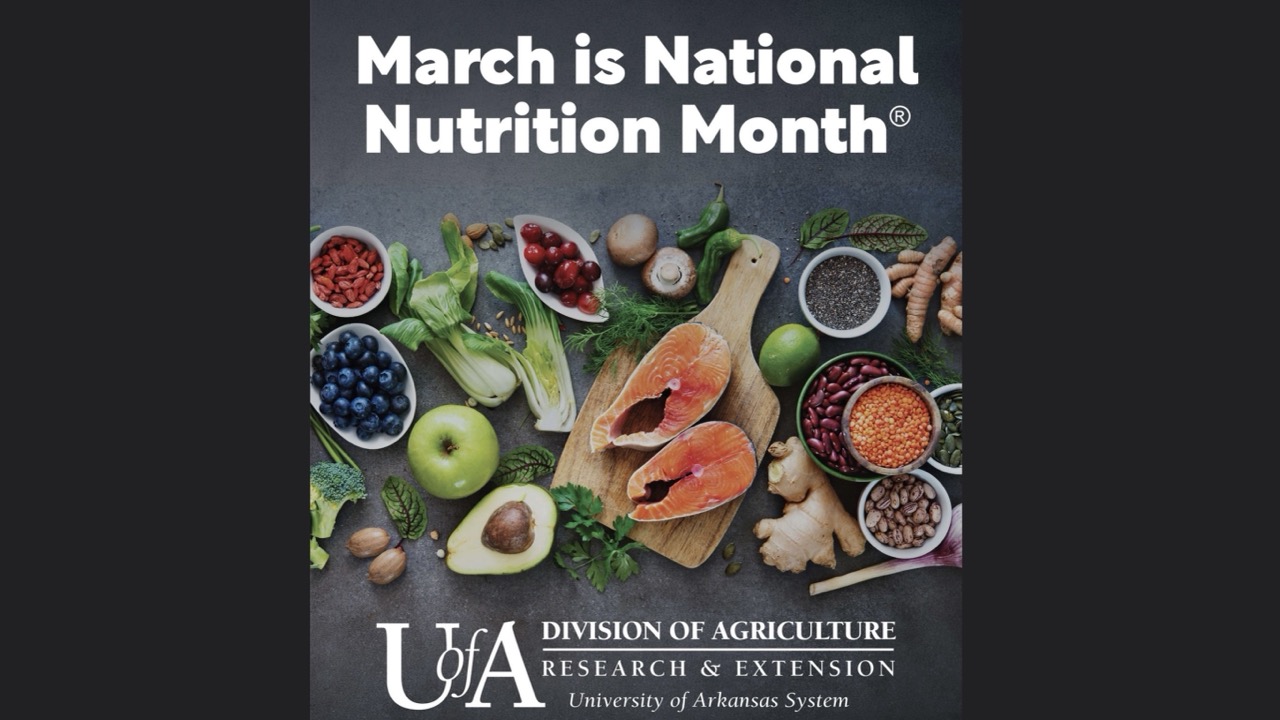
Roofe said that March’s National Nutrition Month® marks a good time to celebrate extension’s critical nutrition programs and the individuals who deliver them.
In 1973, the Academy of Nutrition and Dietetics began celebrating National Nutrition Week, which later became a month-long observance in 1980. This year, the theme of the month is discovering the power of nutrition.
Arkansas extension staff deliver nutrition education through a variety of programs, including the Expanded Food and Nutrition Education Program, or EFNEP. The nation’s first nutrition education program, founded in 1969, EFENP is exclusively delivered by land-grant universities to individuals and families with limited resources.
In 2025, Arkansas EFNEP reached more than 4,000 adults, youth and families throughout the state. Among adult graduates of the program, 97 percent reported adopting healthier nutrition practices.
Through funding from the CDC’s High Obesity Program grant, extension also provides programming around maternal and child nutrition, including through the implementation of local policies that support breastfeeding mothers.
Vivian Okanume, extension health program associate for the High Obesity Program grant, is an NDTR, Certified Lactation Consultant and has a Certification in Public Health credential. In her role, Okanume said she focuses on “policy, systems and environmental change.”
“For example, I help to develop and implement breastfeeding food safety policies for breastmilk storage, handling and preparation, and help to provide professional development opportunities for our participating early care and education centers,” Okanume said. “We also develop and distribute educational and promotional materials that help these centers become breastfeeding-friendly.”
Okanume said she sees nutrition as a “fundamental driver of health,” beginning at the early stages of life.
“There are so many benefits at the beginning of life, even prenatally, where nutrition sets the stage for what’s to come across a lifespan,” Okanume said. “At extension, we have a unique position to put that awareness out there in these communities that are hard to reach — the importance of breastfeeding and all the benefits that it has for mom and baby that will shape outcomes later in life.”
The power of nutrition
Julian Carpenter, Independence County extension family and consumer sciences agent and RDN, said she recently helped a client understand how her doctor wanted her to eat for a health diagnosis.
“I tried to make it as simple as I would want to hear it, and she went on to lose 45 pounds,” Carpenter said. “I recently ran into her playing basketball at the local community center, and she was feeling so much better. She told me it had finally clicked for her on how to eat and maintain her weight loss.”
Carpenter said her hope is that extension’s nutrition professionals are helping to strengthen the organization’s reputation as the go-to source for unbiased health information.
“To put it simply, good nutrition can lead to healthy individuals and strong families, which leads to a productive workforce and thriving communities,” Carpenter said.
After teaching a 4-H summer camp where participants made homemade bread, Coffman said she received a special request from a parent later that fall.
“At Thanksgiving, I had one of the parents message me and say, ‘My 11-year-old is wanting to make that bread for our Thanksgiving meal, can you send me the recipe?’” Coffman said. “That 11-year-old cooking bread for her family is a skill that she’s going to carry with her into adulthood, and she’s also passing it along to her family.
“You may start with an individual in a classroom, but that’s going to impact more than that individual,” Coffman said. “That’s the grassroots of what we do at extension, and I love that part. You’re making it accessible and taking these big, complicated ideas but putting them in layman’s terms.”
Food safety and nutrition
Extension also offers ServSafe training, a nationally recognized credential for food service professionals and entrepreneurs, and food preservation programs, including Preserving for You. Last year, the ServSafe and food preservation programs provided more than 10,000 hours of education to Arkansans through in-person classes, hands-on demonstrations and web-based instruction.
“I focus on bringing evidence-based practice to life by building practical, hands-on skills — whether through food safety trainings like ServSafe or home food preservation programs — so people can confidently adopt behaviors that last over time,” said Quad Whitson, extension culinary nutrition and food safety program associate for the Division of Agriculture and RDN.
“This approach strengthens public health by reducing food safety risks, supports local economies and small food businesses through workforce-relevant training and ultimately improves quality of life across Arkansas communities,” Whitson said.
Learn more about extension health programs and Arkansas food and nutrition resources on the Cooperative Extension Service website.
To learn about extension programs in Arkansas, contact your local Cooperative Extension Service agent or visit uaex.uada.edu. Follow us on Facebook and Instagram. To learn more about the Division of Agriculture, visit uada.edu. To learn more about ag and food research in Arkansas, visit the Arkansas Agricultural Experiment Station at aaes.uada.edu.
About the Division of Agriculture
The University of Arkansas System Division of Agriculture’s mission is to strengthen agriculture, communities, and families by connecting trusted research to the adoption of best practices. Through the Agricultural Experiment Station and the Cooperative Extension Service, the Division of Agriculture conducts research and extension work within the nation’s historic land grant education system.
The Division of Agriculture is one of 20 entities within the University of Arkansas System. It has offices in all 75 counties in Arkansas and faculty on three campuses.
Pursuant to 7 CFR § 15.3, the University of Arkansas System Division of Agriculture offers all its Extension and Research programs and services (including employment) without regard to race, color, sex, national origin, religion, age, disability, marital or veteran status, genetic information, sexual preference, pregnancy or any other legally protected status, and is an equal opportunity institution.