


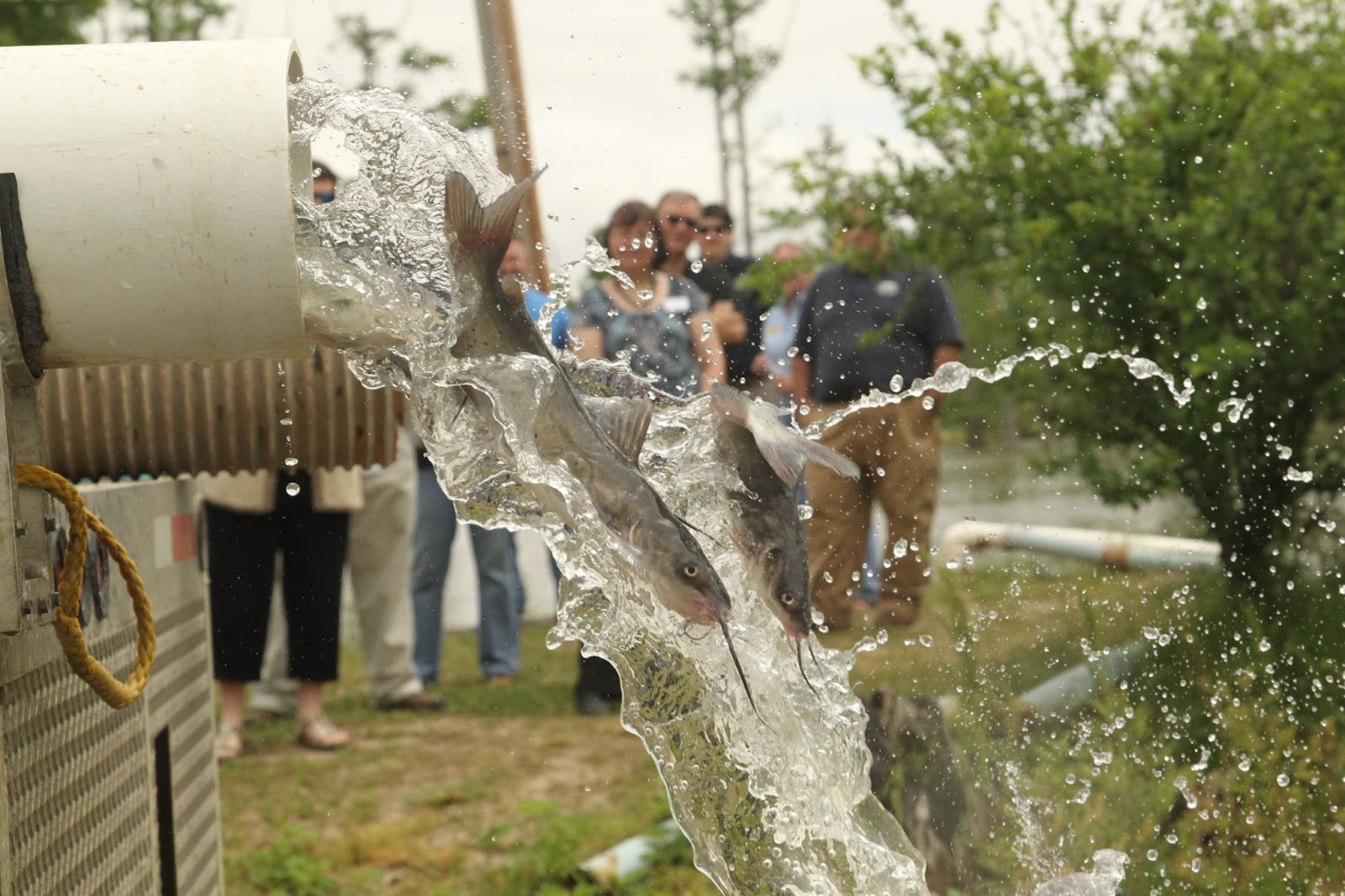
Warm days and long afternoons are back, and the Arkansas Game and Fish Commission has the perfect reason to get out and soak up some sun after school and work. Catchable-sized channel catfish are being shipped from the AGFC’s four warmwater hatcheries to ponds throughout The Natural State for anglers to enjoy.
Hatching Future Memories
The AGFC produces more than 1 million catfish fry each year, with nearly 300,000 of those grown to catchable size (13 inches or greater) for anglers to immediately enjoy at fishing derbies and Family and Community Fishing Program locations. Although it takes many hatcheries and fisheries personnel in Arkansas to make this effort a success, all channel catfish the AGFC stocks start at Joe Hogan State Fish Hatchery in Lonoke, the AGFC’s oldest and largest warmwater hatchery. Chad Wicker, Hogan Hatchery manager, has been working to raise and deliver these and other fish for 21 years.
“It takes 18 months to two years for those catfish to develop from fry to catchable size,” Wicker said. “We spawn the catfish and hatch all the eggs here at Joe Hogan (Hatchery). We’ll hatch more than a million. Some of that is traded to other states for fish they can supply to us. We still end up with about 600,000 fingerlings to grow out through Arkansas hatcheries.”
Wicker said that a typical year will see 100,000 catfish go to the AGFC’s William H. Donham State Fish Hatchery in Corning, 75,000 sent to the C.B “Charlie” Craig State Hatchery in Centerton and 80,000 to 100,000 delivered to the Jim Collins Net Pen Operation on Lake Ouachita to feed and grow.
“We also send some down to the Andrew Hulsey State Hatchery in Hot Springs, but the lion’s share still stay here in Lonoke to grow in our ponds,” Wicker said. “Every hatchery can raise multiple species, but we all specialize in one or two. Ours is catfish.”
During the next 18 months, the catfish are fed a commercial catfish food consisting primarily of grains and proteins to encourage fast growth. Roughly 75 cents to one dollar’s worth of feed goes into each catfish produced, depending on the length of their stay and the size they reach. Include staff time, materials, energy costs to pump and aerate water, fuel for operations and transport of the fish and maintenance of the ponds and grounds, and it’s evident that the AGFC invests a lot of time, money and passion into making memories on the ends of anglers’ hooks.
Local Delivery
Most of the catchable-sized catfish the AGFC delivers are destined for a small pond or section of stream accommodating first-time anglers and those who may not be able to make a long drive to enjoy a day on the water. The agency’s Family and Community Fishing Program, initially envisioned by former Commissioner Tommy Sproles, works to deliver these fish to established park ponds managed by cities and towns throughout the state.
According to Maurice Jackson, FCFP coordinator, the program focuses on locations close to population centers of at least 25,000 residents. The local city or municipality also must agree to help manage and incentivize public access to the fishing opportunity
“The program is all about getting young anglers interested, as well as trying to give anglers of all ages and abilities the opportunity to fish within a short drive or bicycle ride from their home,” Jackson said. “The program celebrated its 50th location statewide last year.”
Family and Community Fishing Program locations are stocked with catfish in spring and fall, depending on the size of the pond and the amount of fishing pressure it is likely to receive. A complete list of FCFP locations, and fishing regulations for these ponds, is available atwww.agfc.com/familyfishing.
Derby Days
The AGFC boosts supplies of fresh catchable-sized catfish in more than just FCFP locations. Hatchery trucks spend hundreds of hours each year hauling fish for fishing derbies and events coordinated by small towns and organizations throughout Arkansas. Churches, civic groups, nursing homes and scout troops are among the organizations partnering with the AGFC’s fishing derby program.
“We want everyone to have a good experience fishing, and fishing derbies are the way a lot of people first learned how fun it can be,” Gary Logan, assistant chief of the AGFC Education Division, said. “Some of the derbies will be held at FCFP locations, but a few other bodies of water are added to the list to increase angler opportunities. When we can, we try to hold multiple events at the same bodies of water to take advantage of fish that were previously stocked still being available to catch.”
According to the AGFC’s Derby Program Webpage, more than 140 derbies are already on the books for 2026.
“We list the organizers’ contact information for each derby alongside its location and date, so that interested anglers can reach out and learn more about the event and how they can participate,” Logan said.
A few derbies focus on a specific group or age range — for example, children, people with disabilities or elderly anglers — but many are geared for families to come out and fish together.
“And the fishing fun doesn’t stop when the derby ends,” Logan said. “These are ponds that are open to public fishing, so you’ll have some good fishing for weeks after the derby, too.”
Visit www.agfc.com/education/